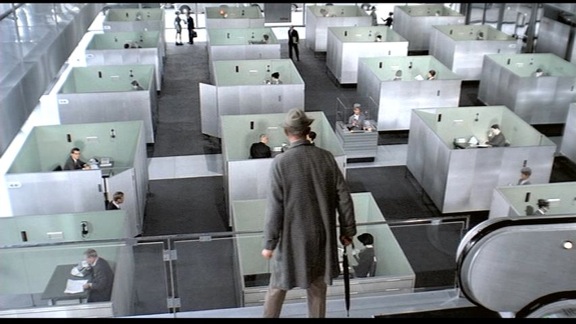
Piece by Matthew Stadler we read in class:
http://fillip.ca/content/re-work-and-boredom
Essay he is referring to by Lorna Brown (on Lars Svendsen, A Philosophy of Boredom*):
http://fillip.ca/content/to-live-real-boredom-one-must-have-style
If you want to hear Lars Svendsen on Joseph Brodsky's extreme solution to boredom:
http://www.youtube.com/watch?v=Wmi3B8H-_As
Very funny piece by Matthew Stadler, “Don’t Take Any Jobs,” on his attempt to use Mechanical Turk to finish an essay. (Don't get any ideas.)
http://fillip.ca/content/dont-take-any-jobs
Tuesday, April 6, 2010

final blog post due April 12 + your final essay due April 27th
For this week you will read two very different accounts of labor, an article by Matthew Crawford entitled, "The Case for Working with Your Hands" and an excerpt from an essay by Diedrich Diederichsen entitled "On Surplus Value," concerned with the value of art and shifts in cultural production. (Mehrwert means surplus value. Please look up any other terms you don't recognize.)
Your post for next week (due next Monday April 12 at 1:00 pm) needs to consider the differences between these two essays and raise any issues you see these writers neglecting, particularly around the specific kind of labor you feel you are being trained to do at CCA. This writing is intended to help you start thinking about the final essay for this course. Please also include a link to a "performance proletarian" (as Diederichsen would call it). Alex's links from last week are excellent examples. We will look at some of these links in class together next week.
The final illustrated essay will be an essay on labor. For this essay you will need to observe multiple modes of labor (including your own if you like). Rich description of these observations should serve as the foundation for reflecting thoughtfully on what work means today, and what it might mean in the future. (This is your chance to reflect on what we have read and discussed over the semester.) Think of this essay as your own version of the GAMES essay by McLuhan or the DEEP PLAY essay by Geertz, (except that your essay will be on DEEP WORK). This essay needs to be 1200 words (minimum)/ 1500 words (maximum) and should take visual or concrete form as something you have designed to be presented to the class on the last day of the semester. Start to think about it now. You need to write up a short (150 word) proposal for your essay that will be due Friday April 16 at 1:00 pm by email. Tell me what you plan to observe and which arguments/texts from the course you plan to take into consideration. If you have a design concept, you should also include a description in your proposal.
Your post for next week (due next Monday April 12 at 1:00 pm) needs to consider the differences between these two essays and raise any issues you see these writers neglecting, particularly around the specific kind of labor you feel you are being trained to do at CCA. This writing is intended to help you start thinking about the final essay for this course. Please also include a link to a "performance proletarian" (as Diederichsen would call it). Alex's links from last week are excellent examples. We will look at some of these links in class together next week.
The final illustrated essay will be an essay on labor. For this essay you will need to observe multiple modes of labor (including your own if you like). Rich description of these observations should serve as the foundation for reflecting thoughtfully on what work means today, and what it might mean in the future. (This is your chance to reflect on what we have read and discussed over the semester.) Think of this essay as your own version of the GAMES essay by McLuhan or the DEEP PLAY essay by Geertz, (except that your essay will be on DEEP WORK). This essay needs to be 1200 words (minimum)/ 1500 words (maximum) and should take visual or concrete form as something you have designed to be presented to the class on the last day of the semester. Start to think about it now. You need to write up a short (150 word) proposal for your essay that will be due Friday April 16 at 1:00 pm by email. Tell me what you plan to observe and which arguments/texts from the course you plan to take into consideration. If you have a design concept, you should also include a description in your proposal.
Monday, April 5, 2010
Without Meaning

Boredom and meaninglessness are such common feelings today that one tends to accept it and forget about it. We are blessed (or, more likely, cursed) with many bandaids for these feelings. They are not the kinds of bandaids which are infused with vitamin e or polysporin, nothing that will actually heal our boredom or lack of meaning, only hold it together and keep it out of the open air so we can forget about it a little while longer. These bandaids present themselves in the form of mp3 players, keeping our ears busy on the bus rides home, portable electronic games, sudoku puzzles, television shows laden with bright colors, loud noises and beautiful people interrupted by advertisements of shiny, delicious things. Don’t even get me started on the internet.
When one is alone and bored today, they are able to alert an alarming number of people (via status updates, tweets, blog posts) as to their condition. In a moment I can discover what someone is eating, where they are headed, what they are thinking of eating, or considering going. This information is meaningless and it is boring. It is only one more way for the writer of such posts to feel as though they are actually doing something, and interacting with others, and for the reader to distract themselves from their life by concentrating on that of another. With all of these things consistently at our fingertips the shutting off outside information and being alone with one's thoughts is increasingly becoming hard work.
Our distractions are boring, which is why we need so many of them. It is not unheard of for one to entertain themselves with multiple distractions at once. I am horrified when I find myself avoiding homework by watching free television shows on my computer of which I am distracting myself with a game of spider solitaire. Our bandaids do not engross us, they only tide us over, we are not alone enough to think, but not involved enough to feel satisfaction. We think we do not have time to move things from one box to another and back again as Walter De Maria suggests. We cannot imagine sitting alone at home, electronics off, blinds closed, and really get to know our sprit as purposed by Siegfried Kracauer. So what is the solution?
I propose that we eliminate the use of our ears and eyes. I am afraid that is the only way. If our ears and eyes are functioning there is no hope for us to turn off the world and spend quality time with ourselves. This could be accomplished using sound blocking head phones, or heavy duty ear muffs combined with a comfortable yet effective blind fold. In order for people to actually disrupt their senses for any period of time it would have to be made incredibly fashionable. The producers of said product will need to hire a fabulous marketing team. The objects should to be sleek, sexy and probably shiny. Several prominent celebrity endorsements are a must. This will ensure that people will buy the ear muffs and blind fold but to encourage people to actually use it is another problem. Maybe if there is a device that tracks how long each person has spent in seclusion and posts it to their facebook account so their friends can see. This will make it competitive, which is an excellent motivator. Of course it will be a trend, and it will run it’s course, and then we will need a new solution, but, for the time being, I believe this is the answer.
Word count 591

Tuesday, March 30, 2010
Boredom, Meaningless Work, and now?

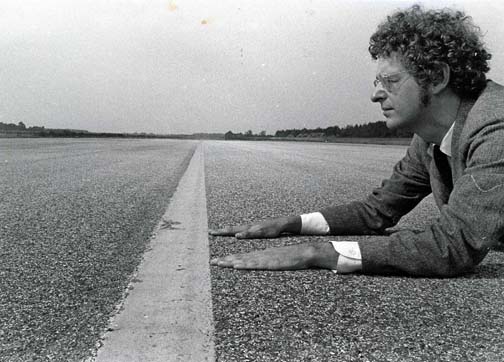
Read "Boredom" by Siegfried Kracauer (1924) and "Meaningless Work" by Walter de Maria (1960). Both writers make some kind of proposal. Both are quite clever and funny in ways specific to their own historical moment. Your assignment is to write a short proposal relevant to your own historical moment in a tone that corresponds to your experience and your generation's perception of work and play. This is a chance to continue to cultivate your own voice and particular sensibility (and wit) as a writer. This is an assignment about voice and observation. What you write should be posted to the blog NO LATER than Monday at 1:00 pm. Please take the time to read other people's posts as well. I'll be asking you about things you noticed the posts have in common (and perhaps how they differ as well). If you have any questions, I'm available by email. Don't wait until the last second to be in touch. Please include a word count. Meaningless Work is also about 500 words, so keep that piece in mind as a kind of model. (Your post can include images and links too. You can post it as a comment below or separately.) If you have any problem posting, please send me your piece by email. I will be happy to post it. Finally, it should go without saying, but this needs to be a polished piece of writing, not a first draft or an unthought stream of consciousness. DO EDIT before you post!
Monday, March 8, 2010
Dérive Assignment + Report Requirements

assignment : mapping the dérive
After rereading Guy Debord’s “Theory of the Dérive” as well as Tom McDonough’s article “Situationist Space” plan to rendezvous with your assigned partner or group. Choose a place that is not one that you usually spend time in. Taking into consideration the descriptions of the dérive in your reading, attempt to identify and pursue a “unitary ambiance.” You will need to negotiate how to discern the qualities of the space you travel through. You will need to consider what Debord might mean when he writes that a dérive involves “playful-constructive behavior and awareness of psychogeographical effects.” Your goal will be to produce a narrative map of your experience. You will present this map as well as a carefully elaborated account of your experience to the class on Tuesday March 30th.
Consider the limitations and strengths of the maps the Situationists made. Your map need not replicate the style of the maps the Situationists made. It must however find a way to negotiate or indicate the tension between conventional modes of mapping and the kind of mapping that psychogeography requires. In other words, it will be your task to present a map capable of charting the “psychogeographic” experience of your derive.
Guy Debord’s “Theory of the Dérive” is available online at:
http://www.bopsecrets.org/SI/2.derive.htm
Report due March 30th in class. 3 pages
1) Give a rich descriptive account of your derive. (1 page) [You will read this section OUT LOUD in class. Come prepared.]
2) Describe how you translated this experience into a map. (1 page)
3) How does your map respond to and even critique what might be limited about Situationist modes of mapping? (1 page)
Report due March 30th in class. 3 pages
1) Give a rich descriptive account of your derive. (1 page) [You will read this section OUT LOUD in class. Come prepared.]
2) Describe how you translated this experience into a map. (1 page)
3) How does your map respond to and even critique what might be limited about Situationist modes of mapping? (1 page)
Monday, March 1, 2010
The Game Is Called Pop.
Pop is an intense game of war - with slim to no blood shed. Two teams, each comprised of three people, charge at each other, hungry for the annihilation of the other team’s balloons. Pop is an active battle, played in a large open space, with only one’s feet for weapons, and cunning, quick footed, coordination as defense. The loud noises and team work make for an exciting, highly interactive game, designed to get players moving, laughing, and strategizing, but more than anything else, having fun!
The game is completed after one team conquers the other, in two out of a possible three rounds. The object of a round is to be the first team to pop the opposing team’s master balloon, after first popping a balloon on an opposing payer’s leg and then writing ‘POP’ on their dry board.


At the beginning of the game each player starts out with a long balloon tied to each ankle as shown in the instructional photographs. Players must keep their hands clasped behind their backs through out all game play. Each team begins by standing on their side of the playing field, divided by a line of tape which must be placed through the middle of the field. Dry erase boards, markers and the happy face master balloon must be placed at each team’s end prior to play.
Once the game is in play, all players are allowed to cross the center line as they wish. When the game has begun both teams charge at each other attempting to stomp on one of the other team’s ankle balloons. When the first of your ankle balloons has been popped you must raise your hands in the air and walk back to your team’s side of the playing field. During the trek back, while your hands are in the air, the opposing team must not try to stomp on your remaining balloon. If you are already on your side of the playing field you may continue without crossing the line. When your last balloon has been popped you must leave the playing field immediately - you are OUT!
After an individual has popped an opponent's balloon he/she is now eligible to write ‘POP’ on the other teams dry board. This is the only time when a player is allowed to remove their hands from behind their back. No player may write ‘POP’, or pop the master balloon until they have first taken out one of the opposition’s ankle balloons. Once “POP” has been written, the large happy faced master balloon must be popped for the round to be won. The word ‘POP’ must legibly say ‘POP’ and fill the entire board. ‘POP’ must be written before the master balloon has been popped. If these actions occur out of order the guilty team automatically loses that round. If a player accidentally pops their own team's master balloon, that team automatically loses.
In the following rounds players continue with the same rules as in the first, but with no replenishing of ankle balloons. A game can be won by eliminating all opposing players from the game.
The game is monitored by two referees, armed with a whistle. Referees are responsible for maintaining the rules. When a whistle is blown all players must freeze and listen to the referees.
In playing our game ‘Pop’, with students who very graciously volunteered their time, we discovered many problems and success. Our original plan was to have a capture the flag type game with three players on each team. The players were to have a small balloon tied to their ankles with string which would be popped by the other team, eliminating them from the game. The object of this game was to conquer the other team’s base.
Once we gathered to try the game out for the first time we, by lucky accident, ended up with long balloon-animal balloons as opposed to the traditional variety. This turned out to be great as these balloons could be tied to the ankle without the use of string and, as they are relatively stiff, their movement along with the foot turned out to be more predictable. These balloons also happen to look quite hilarious, adding humor to our game of war. In playing the game, we recognized the excitement and drama added by a loud popping sound which we hadn’t thought about before.
On our first round we had each team attempt to pop the other team’s master balloon. This lasted about 45 seconds, and gave very little incentive for players to pop each other's balloons as they were mostly interested in capturing the other team’s ‘base’ which took the form of the master balloon. To make the game longer and to encourage the players to go after each other first, we made a rule that before popping the other teams master balloon, each individual must first pop a balloon on the leg of an opponent and then proceed to write the word ‘pop’ on a piece of paper before finally popping the master balloon. This made the game much more exciting and fun, but still lasted a very short period of time. Our final solution to this problem was to have several rounds of the game and to have the balloons lost, carry on to the next round. Our rule to keep ones hands behind their back was of good intentions, but turned out to be mostly redundant as most players forgot to follow this rule, which was designed to keep players from pushing and grabbing. Luckily the players were decent enough not to grab at each other anyway. We decided to keep the rule as a reminder that hands were not to be used, but to be lenient on the policing of the rule as long as no one was using their hands for any naughty business.
We discovered that in this game everyone is not equally equipped to play. Some people, and thus teams, by virtue of aggressiveness or coordination, were simply better than others, so well matched teams are desirable.
Subscribe to:
Posts (Atom)